
How to Stop Hair Loss: A Complete Guide to Protecting Your Hair
Seeing more hair on your pillow, comb, or shower floor can be worrying. However, hair shedding does not always mean you are going bald. Then you need to think, how to stop hair loss I am having?.
In some cases, hair loss happens because of stress, illness, nutritional deficiencies, hormonal changes, or temporary disruption of the hair growth cycle. In other situations, it develops gradually because of genetics and hormonal sensitivity.
The good news is that you do not have to guess what is happening. Understanding the cause is the first step in learning how to stop hair loss and protect your existing hair.
At Dr. Ruz Hair Transplant, we believe effective hair restoration begins with an accurate diagnosis. Instead of recommending the same treatment to everyone, we assess your scalp, hair density, medical history, and long-term goals.
That approach helps you understand your options and make confident decisions about your hair.
Understanding How Hair Grows
Before discussing how to stop hair loss, it helps to understand the natural hair growth cycle.
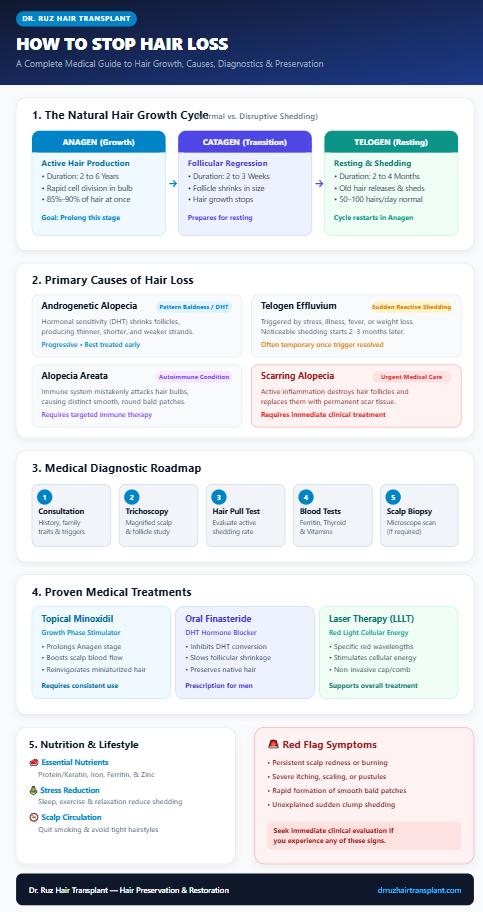
Your scalp contains approximately 100,000 hair follicles. Each follicle produces hair through three main stages:
1. Anagen: The Growth Phase
Anagen is the active growth stage of the hair cycle.
During this phase, cells inside the hair bulb divide rapidly. These cells form the hair shaft, which gradually grows out of the scalp.
The anagen phase usually lasts between two and six years, although the duration varies from person to person. The longer a follicle remains in this phase, the longer the hair can grow.
At any given time, around 85% to 90% of scalp hairs are usually in the growth phase.
2. Catagen: The Transition Phase
After active growth, the follicle enters the catagen phase.
This short transition period usually lasts around two to three weeks. During this stage, the follicle becomes smaller and reduces its activity.
The hair stops growing, but it does not immediately fall out.
3. Telogen: The Resting Phase
The follicle then enters the telogen phase.
This resting stage generally lasts around two to four months. Eventually, the old hair sheds, allowing the follicle to begin a new growth cycle.
Losing approximately 50 to 100 hairs a day can be normal. However, excessive shedding or visible thinning may indicate that something has disrupted the balance of the cycle.
For example, more follicles may enter the resting phase at the same time. Alternatively, some follicles may gradually produce thinner and shorter hairs.
That imbalance can lead to noticeable hair loss.
Suggested Graphic: The Hair Growth Cycle
Create a circular diagram showing:
- Anagen: Active growth
- Catagen: Transition
- Telogen: Resting and shedding
Use simple icons and short explanations so readers can understand the cycle quickly.
Why Does Hair Loss Happen?
Hair loss has several possible causes. Therefore, the best way to stop hair loss depends on identifying the reason behind it.
The most common causes include:
- Androgenetic alopecia
- Telogen effluvium
- Alopecia areata
- Scarring alopecia
- Nutritional deficiencies
- Hormonal changes
- Certain medications
- Medical conditions
- Excessive tension from hairstyles
- Scalp inflammation or infection
Some causes are temporary and reversible. Others require long-term treatment to slow progression and preserve the hair that remains.
Androgenetic Alopecia: The Most Common Cause
Androgenetic alopecia is commonly known as pattern hair loss.
It affects both men and women. In men, it often appears as a receding hairline, thinning at the crown, or a combination of both. Women may notice widening of the parting or diffuse thinning across the top of the scalp.
Genetics play an important role. However, hormones also influence the condition.
A hormone called dihydrotestosterone, or DHT, can bind to genetically sensitive hair follicles. Over time, this process causes follicular miniaturisation.
Miniaturisation means that the follicle gradually produces:
- Thinner hairs
- Shorter hairs
- Less pigmented hairs
- Weaker-looking hair coverage
Eventually, the follicle may produce only very fine hair.
Importantly, androgenetic alopecia is progressive. Therefore, waiting until the hair loss becomes severe may reduce the available treatment options.
Early assessment can help you protect existing hair before more follicles become miniaturised.
Telogen Effluvium: Sudden Hair Shedding
Telogen effluvium causes increased shedding rather than gradual pattern thinning.
It can occur after:
- A significant illness
- High fever
- Surgery
- Major psychological stress
- Rapid weight loss
- Pregnancy or childbirth
- Severe dietary restriction
- Certain medications
- Nutritional deficiencies
The shedding often begins around two to three months after the triggering event.
This delay can make the cause difficult to identify. You may notice hair loss today even though the trigger happened several months earlier.
Fortunately, telogen effluvium is often temporary once the underlying cause has been identified and addressed.
However, persistent shedding still requires medical assessment. Telogen effluvium can sometimes occur alongside androgenetic alopecia.
Alopecia Areata
Alopecia areata is an autoimmune condition that can cause sudden, patchy hair loss.
The immune system mistakenly attacks hair follicles. As a result, patients may develop round or oval bald patches on the scalp.
Some people experience only one patch. Others may develop multiple patches or more extensive hair loss.
Because alopecia areata has different patterns and levels of severity, treatment should follow a proper diagnosis.
Scarring Alopecia
Scarring alopecia requires particular attention.
In this condition, inflammation damages the hair follicle and may replace it with scar tissue. Once the follicle is destroyed, it cannot produce hair normally.
Early treatment is important because doctors may be able to reduce further follicular damage.
Signs that require prompt assessment include:
- Persistent scalp redness
- Burning or tenderness
- Itching
- Scaling
- Pustules
- Smooth shiny areas of scalp
- Hair loss that progresses quickly
Do not assume that every type of hair loss is ordinary pattern baldness. A proper examination can help identify conditions that need urgent care.
How Doctors Diagnose Hair Loss
A successful hair loss treatment plan begins with the right diagnosis.
During a consultation, your doctor may ask about:
- When the hair loss started
- Whether the shedding is sudden or gradual
- Family history of hair loss
- Recent illness or surgery
- Stress levels
- Weight changes
- Diet
- Medication use
- Hormonal symptoms
- Scalp discomfort
- Previous hair loss treatments
Your doctor may also examine the hairline, crown, sides, and donor area.
Trichoscopy
Trichoscopy is a non-invasive examination of the scalp using magnification.
It allows the doctor to assess:
- Hair shaft thickness
- Follicular openings
- Miniaturisation
- Scalp inflammation
- Hair density
- Signs of scarring
- Differences between affected and unaffected areas
This examination can help distinguish pattern hair loss from other conditions.
Hair Pull Test
A hair pull test may help assess active shedding.
The doctor gently pulls a small group of hairs and observes how many come away. The result must be interpreted alongside your history and other examination findings.
Blood Tests
Blood tests may be useful when your history suggests a possible medical or nutritional cause.
Depending on your symptoms, your doctor may consider tests such as:
- Full blood count
- Ferritin
- Thyroid function
- Vitamin levels
- Hormonal investigations
Not everyone needs every test. The right investigations depend on your individual situation.
Scalp Biopsy
A scalp biopsy may be necessary when the diagnosis remains uncertain or when scarring alopecia is suspected.
A small sample of scalp tissue allows the doctor to examine the follicles and surrounding skin under a microscope.
This can help identify inflammation, scarring, or other conditions that may not be obvious during a routine examination.
How to Stop Hair Loss with Medical Treatment
For androgenetic alopecia, medical treatment often forms the foundation of a long-term hair preservation plan.
The two most established medications are topical minoxidil and oral finasteride. However, suitability depends on your health, age, sex, medical history, and treatment goals.
Topical Minoxidil
Minoxidil is available as a topical solution or foam.
It can help prolong the growth phase and support the function of miniaturised hair follicles. Doctors commonly use it to treat pattern hair loss in both men and women, although the recommended formulation and application schedule may vary.
Some people experience increased shedding during the early weeks of treatment. This can happen as follicles shift between growth cycles.
However, increased shedding should not automatically be dismissed. If it is severe, persistent, or accompanied by scalp irritation, seek medical advice.
Minoxidil requires consistent use. Once treatment stops, any benefit may gradually be lost.
Oral Finasteride
Finasteride is commonly prescribed for male pattern hair loss.
It works by reducing the conversion of testosterone into DHT. Lowering DHT can help slow follicular miniaturisation in genetically sensitive follicles.
Doctors commonly prescribe a 1 mg daily dose for male pattern hair loss, but treatment must be assessed individually.
Finasteride is not suitable for everyone. It also requires careful discussion of possible side effects and precautions.
Women who are pregnant or may become pregnant must not handle crushed or broken finasteride tablets because of the risk to a male fetus.
Your doctor should explain the benefits, risks, and alternatives before you begin treatment.
Why Consistency Matters
Hair growth takes time.
Neither minoxidil nor finasteride produces an immediate transformation. The follicles need time to respond, and the results vary between individuals.
Therefore, treatment should be reviewed over several months rather than judged after a few days.
Stopping and restarting treatment without medical guidance may make it difficult to understand whether the treatment is working.
Combining Minoxidil and Finasteride
Some patients benefit from using minoxidil and finasteride together.
The reason is that they work through different mechanisms.
- Finasteride reduces DHT activity.
- Minoxidil supports the growth phase of the follicle.
This combination may provide a more comprehensive approach for suitable patients.
However, combination treatment is not automatically the best choice for everyone. Your doctor should consider your diagnosis, medical history, treatment tolerance, and expectations.
At Dr. Ruz Hair Transplant, we focus on creating a plan that matches your actual hair loss rather than prescribing unnecessary treatments.
Low-Level Laser Therapy
Low-Level Laser Therapy, or LLLT, is another option for selected patients with pattern hair loss.
It is also known as red light therapy or cold laser therapy.
LLLT uses specific light wavelengths to stimulate activity within cells. The treatment may support hair follicle function and encourage follicles to remain in the growth phase.
Devices may include:
- Laser combs
- Laser caps
- Helmet-style devices
- Other approved light-based systems
LLLT is non-invasive, but results depend on the device, treatment schedule, and individual response.
It should be viewed as a possible part of a broader treatment plan rather than a guaranteed solution.
Nutrition and Hair Health
Your hair requires adequate nutrients to grow normally.
Because hair is made mainly of keratin, the body needs sufficient protein and essential nutrients to support hair production.
Nutritional deficiencies may contribute to diffuse shedding. Common concerns include:
- Iron deficiency
- Low ferritin
- Inadequate protein intake
- Zinc deficiency
- Certain vitamin deficiencies
However, taking supplements without a confirmed deficiency is not always helpful.
Excessive intake of some vitamins and minerals can also cause problems, including hair shedding.
Therefore, focus on a balanced diet that includes:
- Lean protein
- Eggs
- Fish
- Legumes
- Vegetables
- Fruits
- Whole grains
- Healthy fats
If your doctor identifies a deficiency, targeted supplementation may help correct the problem.
Lifestyle Habits That Support Hair Preservation
Lifestyle changes cannot reverse every form of hair loss. Nevertheless, they can support general scalp and hair health.
Manage Stress
Significant stress can trigger telogen effluvium.
You may not be able to remove every source of stress, but you can improve how your body handles it.
Useful habits include:
- Regular physical activity
- Consistent sleep
- Relaxation exercises
- Time outdoors
- Social support
- Professional support when needed
Avoid Smoking
Smoking exposes the body to harmful substances that may affect circulation and tissue health.
Avoiding smoking supports your overall health and may help reduce additional stress on the scalp.
Protect Your Scalp from Excessive Sun Exposure
Long-term ultraviolet exposure can damage the skin.
When spending extended time outdoors, consider wearing a suitable hat or using scalp sunscreen where appropriate.
Use Gentle Hair Care
Avoid excessive pulling, harsh chemical treatments, and very tight hairstyles.
Choose a mild shampoo and wash your scalp according to your oil production and activity level.
Regular washing does not cause pattern hair loss. However, harsh products or aggressive scrubbing may irritate the scalp.
Emerging and Off-Label Treatments
Some patients may hear about treatments such as:
- Dutasteride
- Spironolactone
- Cyproterone acetate
- Platelet-rich plasma therapy
- Microneedling
- Other regenerative treatments
These options may be appropriate in selected cases. However, not every treatment is suitable for every patient, and some are used off-label for hair loss.
Dutasteride
Dutasteride inhibits more than one type of 5-alpha-reductase enzyme. It is approved for certain prostate conditions and may be prescribed off-label for hair loss in selected patients.
Your doctor should explain the potential benefits and risks before considering it.
Spironolactone
Spironolactone may help some women with hormonally influenced hair loss.
It affects androgen activity and is sometimes used when appropriate. However, it requires medical supervision and is not suitable during pregnancy.
Platelet-Rich Plasma
Platelet-rich plasma, or PRP, involves drawing a small amount of your blood, processing it, and injecting a platelet-concentrated preparation into selected scalp areas.
PRP may support hair follicle activity in some patients. However, protocols vary, and results are not guaranteed.
It should be recommended only after assessing the cause and severity of hair loss.
When Is a Hair Transplant Appropriate?
A hair transplant may be considered when hair loss has caused permanent thinning and medical treatment alone cannot provide the desired coverage.
However, a transplant does not stop the underlying process of genetic hair loss.
The procedure moves hair follicles from a donor area to areas affected by thinning. The transplanted follicles may continue growing because of their relative resistance to DHT.
Follicular Unit Extraction
Follicular Unit Extraction, or FUE, involves removing individual follicular units from the donor area.
The surgeon then places the grafts into carefully designed recipient sites.
FUE does not require removing a strip of scalp. However, it still involves surgery and can leave small scars at the extraction sites.
Follicular Unit Transplantation
Follicular Unit Transplantation, or FUT, involves removing a narrow strip of scalp from the donor area.
The strip is divided into individual follicular grafts, which are then transplanted into the thinning areas.
FUT can leave a linear scar. However, the appearance of the scar depends on surgical technique, healing, and individual factors.
Natural Hairline Design
A natural result requires more than placing grafts into empty areas.
The surgeon must consider:
- Your age
- Facial proportions
- Existing hairline
- Donor supply
- Hair thickness
- Hair direction
- Hair angle
- Future hair loss
- Long-term maintenance
Single-hair grafts are often used near the front hairline to create a softer transition. Larger grafts may be placed behind the hairline to improve density.
The goal is not simply to create more hair. It is to create a result that looks appropriate for your face and remains practical as you age.
Why Medical Treatment Still Matters After a Hair Transplant
A hair transplant replaces selected areas of lost hair. It does not prevent non-transplanted hair from continuing to thin.
Therefore, medical treatment may still be important after surgery.
Minoxidil, finasteride, or another treatment may help preserve native hair, depending on your diagnosis and suitability.
At Dr. Ruz Hair Transplant, we also emphasize long-term follow-up. Our comprehensive follow-up approach helps patients monitor healing, hair growth, and the condition of their existing hair over time.
A Practical Plan for How to Stop Hair Loss
If you want to take action, start with these steps:
Step 1: Identify the Cause
Do not assume that every type of hair loss is genetic. Arrange a proper assessment if shedding is persistent, sudden, patchy, or progressive.
Step 2: Protect Existing Hair
If you have pattern hair loss, early treatment may help slow further thinning.
Step 3: Follow a Consistent Treatment Plan
Use prescribed treatments as directed. Give the treatment enough time to work before judging the outcome.
Step 4: Correct Any Deficiencies
If testing identifies a nutritional or medical problem, address it with professional guidance.
Step 5: Review Your Progress
Hair loss treatment requires monitoring. Your doctor may adjust your plan according to your response and changing needs.
Step 6: Consider Hair Transplantation When Appropriate
If permanent thinning remains despite suitable treatment, a hair transplant may help restore coverage and improve the appearance of your hairline.
Conclusion: Start Early and Make an Informed Decision
Learning how to stop hair loss begins with understanding what is causing it.
Some types of hair loss improve after correcting an underlying problem. Others require long-term medical treatment to slow progression. When permanent thinning develops, hair transplantation may offer another option.
The most important step is not to rely on guesswork.
At Dr. Ruz Hair Transplant, we assess your hair loss carefully and explain the available options in clear, practical language. Whether you need medical treatment, lifestyle guidance, further investigation, or a surgical plan, our goal is to help you make an informed decision.
Ready to understand your hair loss and protect your hair’s future?
Visit drruzhairtransplant.com to arrange a consultation with Dr. Ruz Hair Transplant.
Because your confidence determines your future.